Runtime
How long will a 1000Wh power station last?
You have a 1,000 Wh pack, or you are about to buy one. The listing does not say how many hours. That number is the load, not the battery.
The short answer
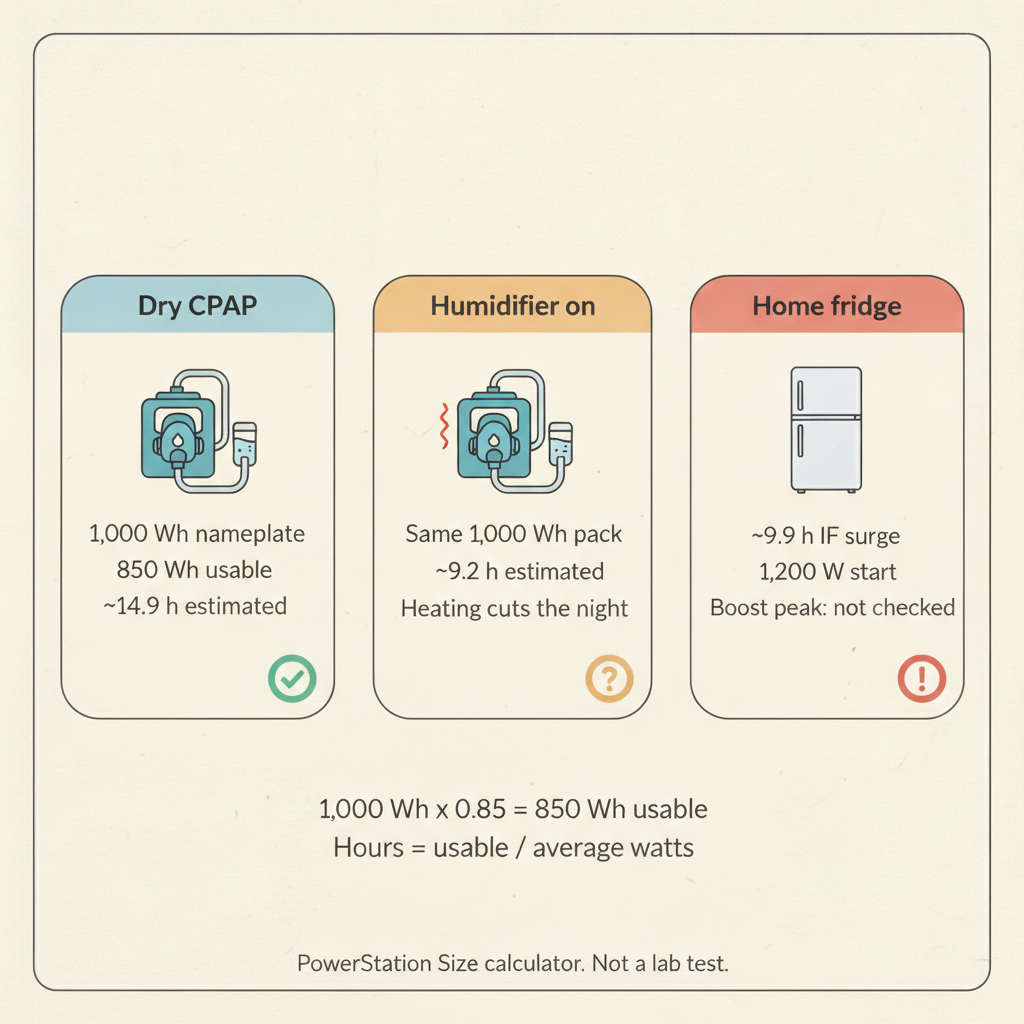
Treat 1,000 Wh as 850 Wh you can actually spend. A dry CPAP night in this catalog lasts about 14.9 h. Turn the humidifier on and it drops to about 9.2 h. A home fridge that the inverter can start lasts about 9.9 h on the duty-weighted average, or about 4.6 h if the compressor never cycles off. If the peak on the box is SurgePad or another boost rating, this site does not count those fridge hours.
1,000 Wh is not a runtime
Watt-hours are a tank. Hours are tank divided by how fast you drain it. Retail titles often print 1,000 W and 1,000 Wh as if they were interchangeable. They are not. Seewatts versus watt-hours.
The context behind "all day"
"All day" on a product page usually assumes a light mix: phones, a laptop, LED lights. A fridge compressor or a heated CPAP humidifier is a different drain. The same 1,000 Wh pack is a long night or a short one depending on which of those you plug in.
How the hours are calculated
Usable watt-hours = 1,000 × 0.85 = 850. Average draw is each device's watts times its duty cycle. Hours = 850 ÷ that draw. A fridge at 150 W and 35 percent duty is 52.5 W average, not 150 W all night. Worst-case hours (everything at nameplate, no duty) are shorter; the table uses the duty-weighted figure, same as the calculator's "average" runtime.
Hours at a constant draw
If the load never cycles, hours are just 850 divided by watts. This is the same idea as a half-life table: the tank is fixed, the drain rate changes the clock. A fridge nameplate is not a constant draw. Use this table for heaters, routers, and other loads that sit on.
| Continuous load | Estimated hours | What that looks like |
|---|---|---|
| 50 W | 17.0 h | A dry CPAP is in this neighborhood. |
| 60 W | 14.2 h | Laptop charger, lights, a phone. |
| 80 W | 10.6 h | Heated CPAP in this catalog. |
| 100 W | 8.5 h | A round number people type into search. |
| 150 W | 5.7 h | Fridge nameplate if the compressor never stopped. It does. |
| 200 W | 4.3 h | A small TV plus a laptop. |
| 300 W | 2.8 h | A blender, a game console, a short kitchen load. |
| 500 W | 1.7 h | A microwave burst, not a night. |
| 1,000 W | 0.8 h | The inverter may hold it. The tank is empty in under an hour. |
These hours ignore motor start. A 1,000 W heater is resistive. A 1,000 W saw is not.
Three real loads at 24 hours of backup
The question is not only "how long." It is whether 1,000 Wh covers the night you actually have. These three use the same 850 Wh usable tank.
Scenario 1: Dry CPAP, 8 h
- Load: 45 W machine plus a 12 W phone charge (2 h).
- Average draw: 57 W. No compressor start modelled.
- Hours from 850 Wh: 14.9 h. Shop figure for a new pack: 542 Wh after inverter loss and reserve.
- At 24 hours of backup you would need more tank, or a second night on the wall. One 1,000 Wh pack covers one prescribed night in this catalog, not three.
Scenario 2: Heated humidifier, 8 h
- Load: 80 W machine plus the same phone charge.
- Average draw: 92 W.
- Hours: 9.2 h. Shop figure: 937 Wh. Heating is the variable that changes the size you buy.
- A 1,000 Wh pack still covers one night here, with less spare than the dry case. Do not turn the humidifier off to fit the battery unless your clinician says that is appropriate.
Scenario 3: Home fridge, 8 h, plus router and lights
- Fridge 150 W at 35 percent duty (420 Wh raw), router 12 W × 8 h, lamps, a phone.
- Average draw: 85.5 W. Start: 1,200 W.
- Duty-weighted hours: 9.9 h. If the compressor never stopped: 4.6 h. Shop figure: 826 Wh.
- Capacity is the easy half. A boost-only 1,000 Wh pack is surge-unverified on this load. That is the C1000 case.
A camping day with a 12V fridge sits between these: 8.3 h average,6.3 h if nothing cycles, start about 500 W.Camping picks.
Average hours versus worst case
The calculator prints two clocks. Average hours apply duty cycle (the fridge compressor rests). Worst-case hours assume every device draws nameplate watts at once, continuously. For a dry CPAP they are the same, because duty is 100 percent. For the fridge they split:9.9 h versus 4.6 h. If you are sizing an outage and you do not know the duty, believe the worse number.
Same 1,000 Wh, four loads
Hypothetical 1,000 Wh nameplate, 1,500 W continuous, 3,000 W inverter surge. Open a row to change watts or hours.
| Load | 1,000 Wh pack | Shop about |
|---|---|---|
| CPAP night, humidifier off57 W running | Clears this load14.9 h est. | 542 Wh |
| CPAP night, humidifier on92 W running | Clears this load9.2 h est. | 937 Wh |
| Camping day (12V fridge)136 W running · start 500 W | Clears this load8.3 h est. | 809 Wh |
| Home fridge outage, 8 h183 W running · start 1,200 W | Clears this load9.9 h est. | 826 Wh |
What is inside the fridge row
Raw energy before inverter loss is 585 Wh. The shop figure (826 Wh) divides by 0.85 and multiplies by 1.20. Runtime on a pack you already own uses 850 Wh, not the shop figure.
| Device | Running | Duty | Energy | Start |
|---|---|---|---|---|
| Home refrigerator (full size) | 150 W | 35% | 420 Wh | 1,200 W |
| Wi-Fi router / modem | 12 W | 100% | 96 Wh | — |
| LED lamp | 9 W | 100% | 45 Wh | — |
| Phone charge | 12 W | 100% | 24 Wh | — |
What actually changes the hours
This is the factor retail copy skips, the way cutoff skipped EtG math.
A 500 ng/mL versus 100 ng/mL cutoff changed that test by half a day. Here the equivalent split is duty cycle and surge. Two 1,000 Wh packs with the same tank print different fridge answers if one peak is inverter surge and the other is SurgePad.
Cold cuts usable capacity. An old LiFePO4 pack that has seen 3,000 cycles is not a new 1,000 Wh. Inverter efficiency below 0.85 (a cheap modified-sine unit, a long extension cord) eats hours the same way. None of those are in the headline watt-hour number.
Three real ~1 kWh stations
Nameplates are 1,024 to 1,070 Wh, not a round 1,000. Hours move a little. The surge label moves the fridge column. Affiliate links may earn a commission.
#1
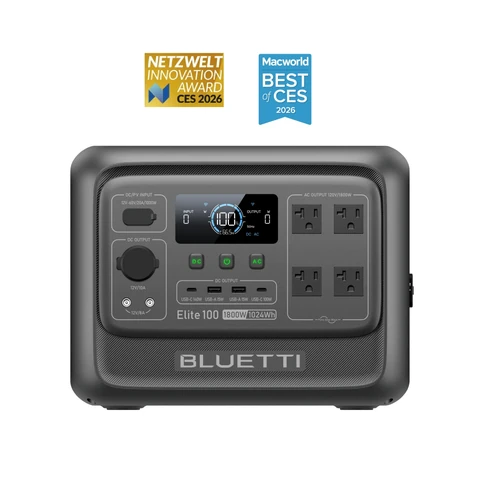
BLUETTI Elite 100 V2
1,024 Wh · inverter surge
- Dry CPAP
- 15.3 h
- Heated CPAP
- 9.5 h
- Home fridge
- Clears this load
- 10.2 h
#2
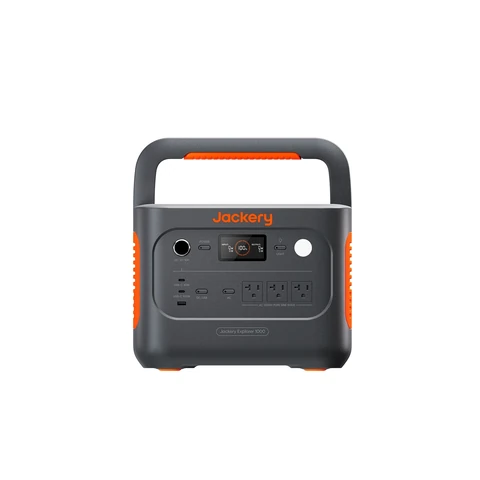
Jackery Explorer 1000 v2
1,070 Wh · inverter surge
- Dry CPAP
- 16.0 h
- Heated CPAP
- 9.9 h
- Home fridge
- Clears this load
- 10.6 h
#3
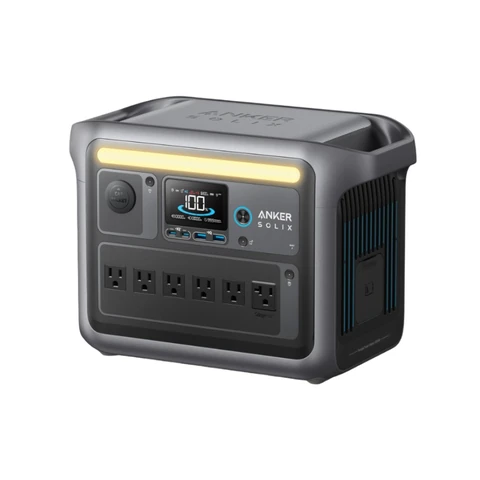
Anker SOLIX C1000
1,056 Wh · boost peak
- Dry CPAP
- 15.7 h
- Heated CPAP
- 9.8 h
- Home fridge
- Boost only, not checked
- 10.5 h
What will not add hours
A louder watt number on the same tank
2,000 W continuous on 1,000 Wh is still 1,000 Wh. You get headroom, not a longer night.
Treating boost as a fridge start
C1000 holds similar watt-hours. Its 2,400 W peak is SurgePad. Fridge hours stay unverified on this site.Can a power station run a refrigerator?
Running the pack to 0%
The 85 percent usable factor is there so the estimate does not assume an empty battery at sunrise. Cold weather and an old pack cut that further.
Solar on a cloudy day
A 400 W panel is a charge rate in sun, not 400 extra watt-hours in the case. Night runtime is still the tank you started with.How to size a solar generator.
Frequently asked questions
How long will a 1000Wh power station last?
On this site a 1,000 Wh nameplate is 850 Wh usable. A dry CPAP night lasts about 14.9 h. A heated-humidifier night lasts about 9.2 h. A home fridge that the inverter can start lasts about 9.9 h on the duty-weighted average, or about 4.6 h if the compressor never stops. Hours change with the load. The 1,000 Wh figure is not a runtime.
Why is usable capacity only 850 Wh?
The calculator treats 85 percent of nameplate as usable so the estimate does not assume you run the pack to empty. Inverter conversion is a separate 0.85 factor on the shop-capacity formula. Both are on the methodology page.
Will a 1000Wh station run a refrigerator?
Capacity is usually enough for about 10 hours in the 8-hour home-fridge example, using 35 percent compressor duty. The gate is inverter surge, about 1,200 W. A 1,000 Wh pack with a boost-only peak is not cleared for that start here.
Does 1000W mean the same as 1000Wh?
No. Watts are output. Watt-hours are stored energy. A 1,000 W inverter on a 500 Wh pack is still a short pack.
How long does 1000Wh last at 100 watts?
850 Wh usable divided by 100 W is 8.5 hours, if that 100 W is continuous and the inverter can hold it. A fridge nameplate of 150 W is not 150 W all night; duty cycle changes the hours.
How long does 1000Wh last overnight?
A dry CPAP night in this catalog is about 14.9 h. A heated humidifier night is about 9.2 h. Eight hours of a cycling home fridge is about 9.9 h only if surge is published.
How do I get hours for my devices?
Open the calculator, add the devices, and switch to runtime on a verified model. The first line names whether capacity, continuous watts, or surge fails first.
Related reading
Calculate your own hours
Prefill a load, then pick a verified model in runtime mode. The first line names the binding limit.