Sizing basics
Watts vs watt-hours: which number actually sizes the station
The listing says 1,000 W. You need the fridge overnight. Those are not the same unit, and mixing them is how people buy a pack that trips on the first compressor start, or dies in 40 minutes.
The short answer
Watts (W) tell you whether the inverter can hold the load. Watt-hours (Wh) tell you how long the battery lasts. You need both. A third check, inverter surge, decides motor starts. A single "1,000 W portable power station" headline answers none of those by itself.
What each number is
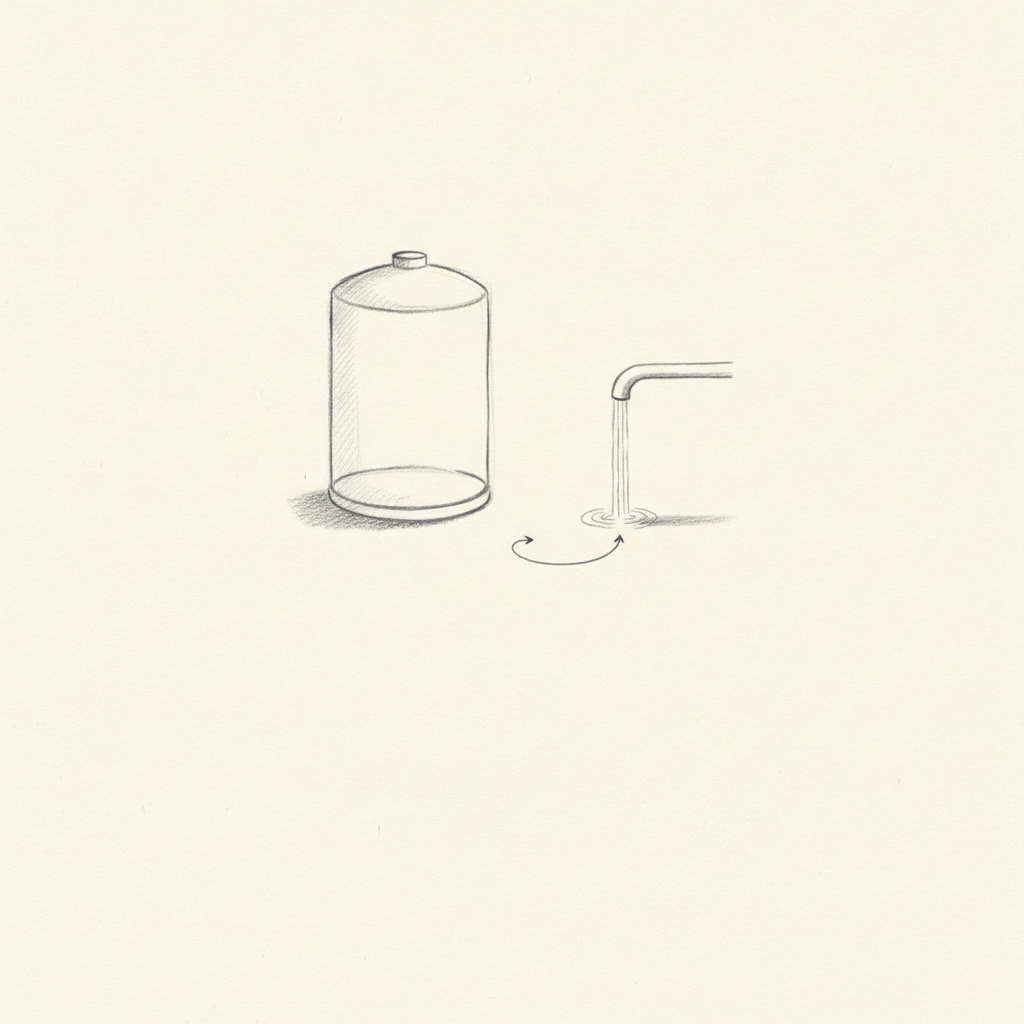
Watts are a rate. A 60 W bulb uses 60 joules per second. Run it for ten hours and you have used 600 Wh. The station's output rating is the ceiling on that rate. The capacity rating is the tank.
On a spec sheet, continuous watts are the running ceiling. Peak watts are either inverter surge or a resistive boost. Capacity is watt-hours. This site checks them separately so a large tank cannot hide a weak inverter, and a loud watt number cannot hide an empty tank.
The 1,000 W pack is misleading
Retail titles often lead with watts because the number looks bigger. Search "1000W power station" and you will see packs from a few hundred watt-hours to well over 1,000 Wh sharing the same headline wattage.
The context behind "1,000 W"
1,000 W means the inverter can hold about a 1,000 W running load. It does not mean you have 1,000 Wh in the battery. A 1,000 W / 500 Wh pack at a 1,000 W load lasts on the order of half an hour before losses, not a night. The same 1,000 W inverter on a 1,024 Wh pack is a different purchase.
For a fridge, even 1,000 W continuous can be the wrong gate. The start in this catalog is about 1,200 W of inverter surge. Matching the running watts is not the same check.
How the hours fall out
Roughly: watt-hours in the tank, times 0.85 usable, divided by the duty-weighted watts. Then compare continuous watts to the load, and inverter surge to the largest motor start. Thecalculatornames which of those three fails first.
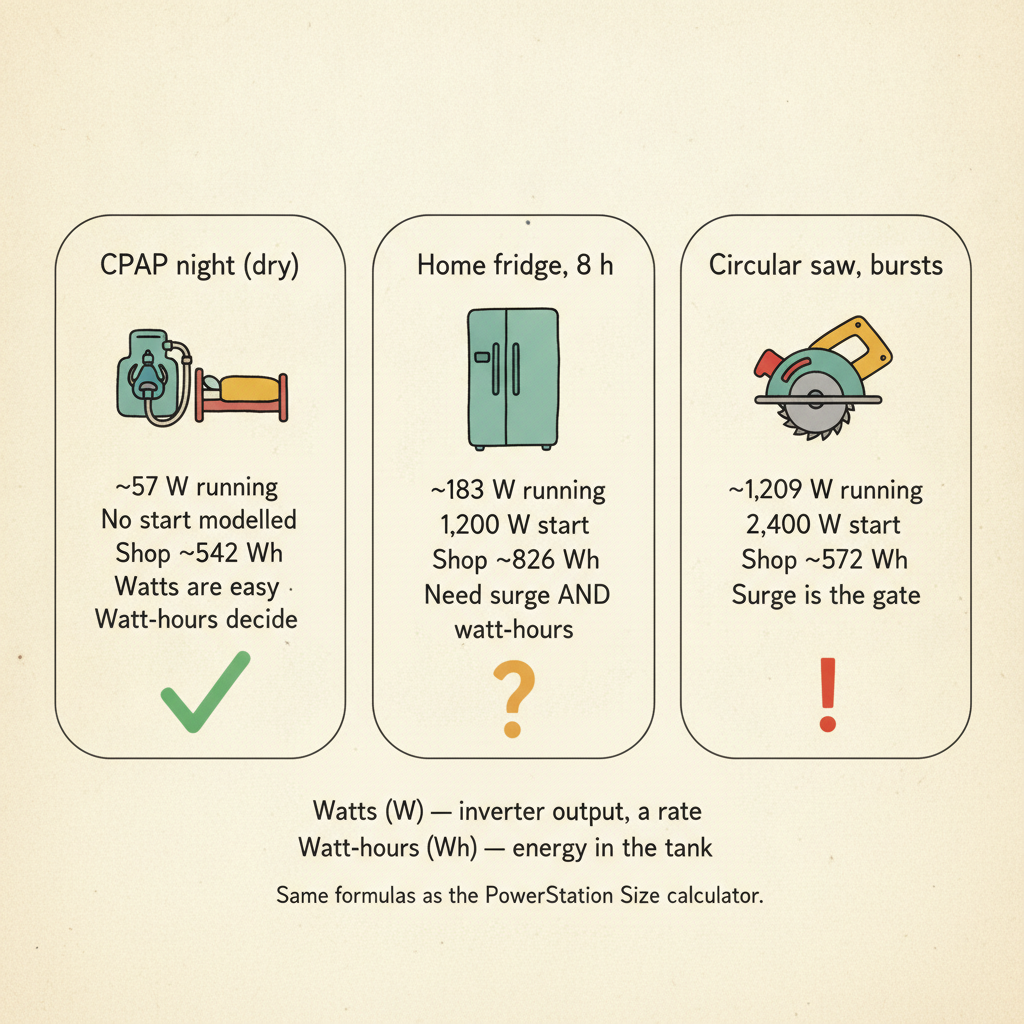
| Load | Running / start | Shop about |
|---|---|---|
| CPAP, humidifier off, 8 h | 57 W / no start modelled | 542 Wh |
| Home fridge outage, 8 h | 183 W / 1,200 W start | 826 Wh |
| Circular saw, bursts | 1,209 W / 2,400 W start | 572 Wh |
Shop figures include inverter loss and reserve. The saw is a surge problem. The CPAP is a watt-hour problem. The fridge is both.
Three ways the mix-up shows up
Scenario 1: CPAP night
Draw is small, on the order of 57 W dry. Almost any mid-size inverter holds it. The number that decides the purchase is watt-hours for eight hours, and whether the humidifier is on. SeeCPAP backup.
Scenario 2: Home fridge
Running watts look modest. Startup is about 1,200 W. Capacity around826 Wh covers eight hours in this catalog only if the peak is inverter surge.Can a power station run a refrigerator?
Scenario 3: A saw
Capacity can be small because the tool runs in bursts. The start is about 2,400 W. Extra watt-hours do not pull the trigger. A boost rating does not either.Power tool scenario.
What will not help
Buying the louder watt number
2,000 W continuous on a 500 Wh pack is still 500 Wh. You get headroom, not hours.
Treating panel watts as extra battery
A 400 W panel is a charge rate in sun, after angle and weather. It is not 400 Wh sitting in the case. That split is onhow to size a solar generator.
Ignoring surge because capacity looks big
A 2 kWh pack with a boost-only peak still fails a fridge start on this site.Surge versus boost.
Frequently asked questions
What is the difference between watts and watt-hours?
Watts (W) are how fast energy moves: output. Watt-hours (Wh) are how much is stored: capacity. A 1,000 W station can still hold only 500 Wh, which is about 30 minutes at 1,000 W, not a night.
Is 1,000 W enough for a fridge?
1,000 W is output, not runtime. A full-size fridge in this catalog runs near 150 W but starts near 1,200 W. You need inverter surge for the start and watt-hours for the hours. One number cannot answer both.
How many watt-hours do I need for a CPAP night?
A dry CPAP night in this catalog shops about 542 Wh after inverter loss and reserve. A heated humidifier night is larger. Watts on the box do not size that night.
Does a higher watt rating mean longer runtime?
No. Higher watts mean the inverter can hold a heavier load. Runtime is capacity divided by the load, after losses. A 2,000 W inverter on a 500 Wh pack is still a short pack.
What is a solar generator, then?
A battery with an optional solar input. Panel watts are a charge rate in sun, not extra watt-hours in the pack. See how to size a solar generator for that split.
Related reading
Calculate your own estimate
Add the devices you actually run. The first line of the result says whether you are short on watt-hours, continuous watts, or startup surge.